Alexander Beznes, LCSW is a licensed bilingual psychotherapist in New York City working with individuals, couples, and groups navigating identity, displacement, relational trauma, isolation, and the experience of not quite belonging anywhere.
Individual Psychotherapy
Therapy is a space full of potential and possibility. I work with people who are trying to make sense of themselves, their patterns, their histories, and the gap between who they are and who they want to be. The shame of that distance is often what we’re working with most. I bring an attentive, unhurried presence to that process, curious about your experience, honest about what I notice, committed to staying with what’s actually happening in the here-and-now. I don’t work from a fixed script. Depending on what feels indicated, we might work through a memory, sit with a sensation in the body, or find a metaphor that opens something up. What matters is that you surprise yourself.
The work is relational at its core. What organizes your inner life tends to show up in how you relate to others, and how you relate to others tends to show up in the room between us. That is where the most fruitful and meaningful work happens. Along with our internalized relationship dynamics, we encode ways of coping, strategies and defenses that once helped us protect, soothe, and survive. Tension, sensation, and physical memory live in the body alongside our relational patterns. Working somatically, through EMDR and other approaches, we build awareness of what the body is holding, its postures, reactions, and the sensations that accompany old ways of coping, and find ways to move through what has gotten stuck.
Eye Movement Desensitization Reprocessing (EMDR)
Eye Movement Desensitization and Reprocessing (EMDR) is a structured, evidence-based therapy highly effective in the treatment of trauma and a wide range of other difficulties. Working through bilateral stimulation, eye movements or tapping, we process memories and experiences that have gotten stuck, regulating their emotional intensity and facilitating deeper integration. The goal is to reduce distress, shift the negative beliefs that have formed around painful experiences, and build greater capacity to move through the world.
Bilingual and Bicultural Therapy
I offer sessions in English and Russian. For clients navigating a bicultural identity or the particular weight of displacement, there is something about working with someone who knows the language, the mannerisms, the cultural loadings, who doesn’t need things explained. The relief of being understood without having to translate yourself is sometimes where the work begins.
Couples Counseling
Couples work begins with the relationship in the room, what’s happening between you right now, not just the history of how you got here.
A substantial part of the work is discovering the relational patterns and moves within your relationship. We’ll examine how familial dynamics influence the ways in which we’ve learned to get our needs met and how this may be leading to conflict and impasse. I pay close attention to the moments when someone is trying to be understood and not quite reaching their partner, when pain is visible but not yet accessible between them. Part of the work is slowing things down, reflecting what I see, and highlighting the attempts to connect and what follows from them. The goal is to help you stay in the here-and-now rather than getting pulled back into familiar patterns and resentments, until something new becomes possible.
Group Therapy
In group therapy, the work happens in the space between people. When someone brings something difficult into the room, the response comes from others who recognize themselves in it. There are things you can ask a group that you can never ask a friend.
The groups I facilitate are fraternal, friendly, and genuinely conversational. Over time, members hold one another in mind, connect around shared experiences, and use what they heard from someone else to move something forward. A connectivity develops that extends well beyond the hour.
My role is to hold the structure and keep the group’s attention on what is actually happening between people in real time. Patterns that organize someone’s life tend to surface in how they relate to others in the room. Over time, we attend to what’s happening between us, develop new language for what we carry, and build ways of relating that once didn’t feel possible.
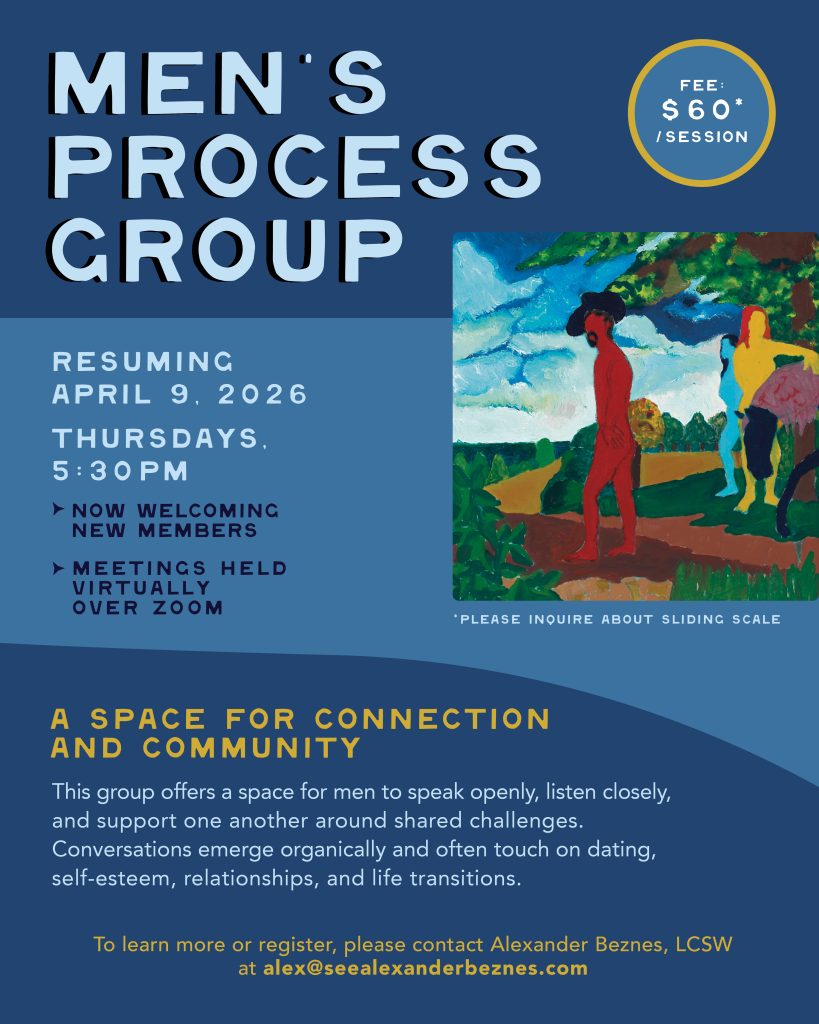
Men’s Process Group
I started running men’s process groups in January 2026 in response to the isolation that many men experience in their lives. It’s a feeling most of us know, wondering whether we’re alone in our struggles or if others are facing similar challenges.
The group is established, ongoing, and currently at capacity. Those interested in joining are welcome to join a waitlist or inquire about the new group forming this fall.
Men who find this work most useful bring openness, introspective capacity, and some readiness to be curious about their own role in the patterns that have organized their life.
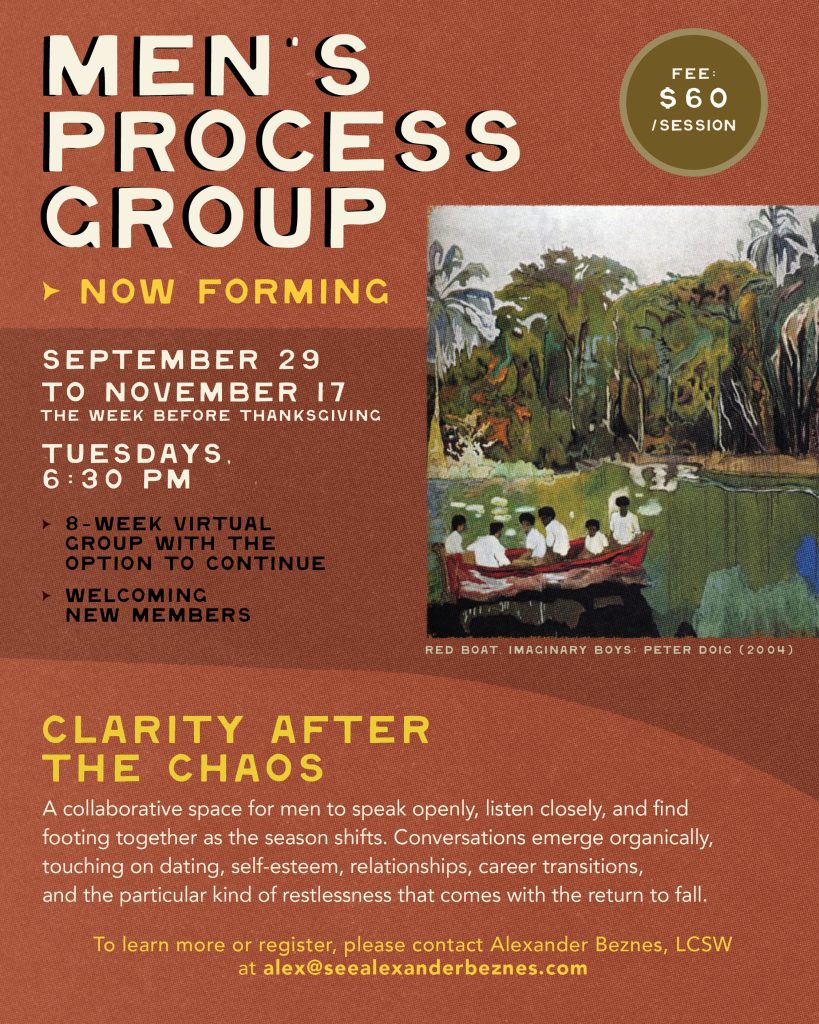
New Group Forming Fall 2026
The last stretch of summer. Colors melting together, days bleeding into one another, skin sticking, eyes squinting through the haze. And yet, in spite of the heat, there is already a subtle chill in the night air. Something is shifting.
This time of year has a way of leaving us unmoored. The structure falls away, the weeks blur, and by the end we can feel lost and disconnected, unsure of what comes next. As the season turns, it can be hard to navigate the return.
I’m forming this group as an anchor as the chaos of summer settles. A space to reflect, reconnect, and find footing for the fall.
Community
Beyond individual and group therapy, I maintain a commitment to pro bono and community-based work with refugees and underserved populations through PPSC and other community partners.
Consultations
Taking the first step to reach out can be daunting whether you’re looking to begin treatment for the first time or have prior experience with therapy. A consultation can be a great way to get a sense of how it would be like to speak with me about your current difficulties and intentions for therapy. I’m looking forward to hearing how the process has been for you and learning more about you.